What is local SEO and who needs it?
Local SEO is the work of making your business appear when people search for services near them, in the map results and in the standard results. Any business that serves customers in a specific area needs it: tradespeople, clinics, law and accounting practices, restaurants, salons, and service companies that travel to customers.
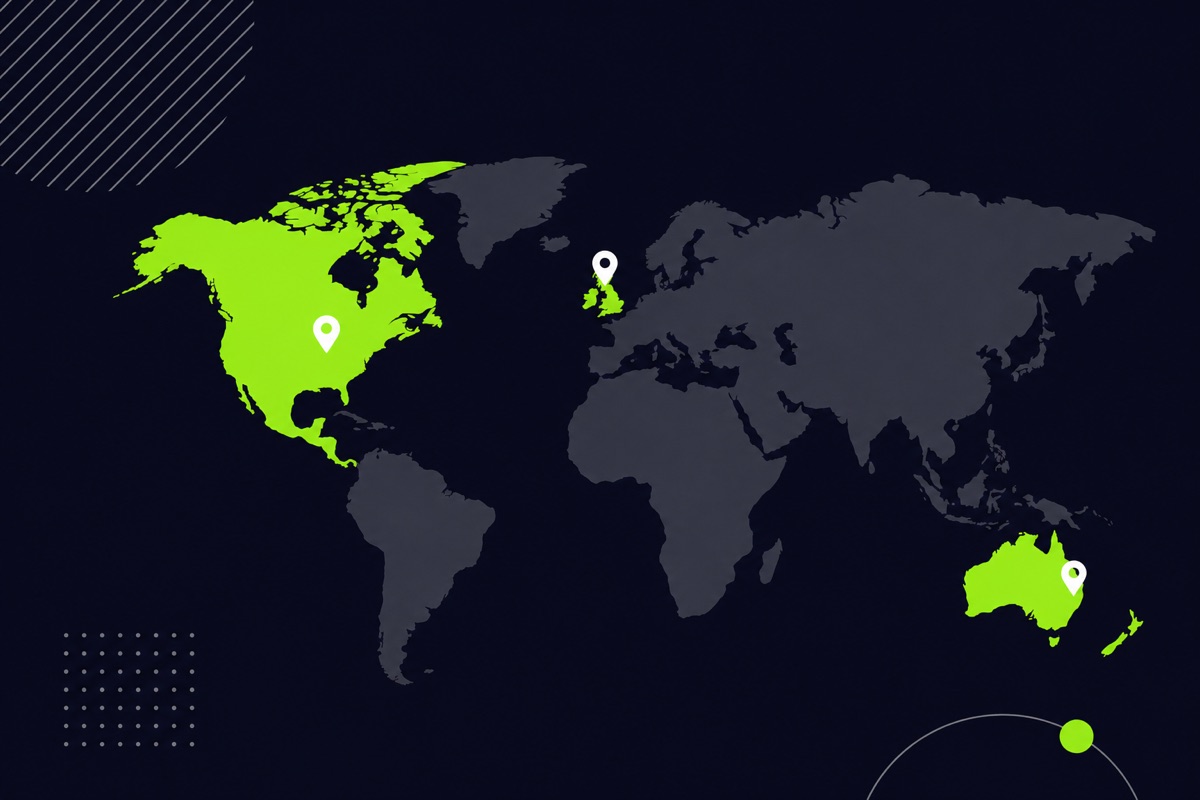
The fundamentals are shared across the US, Canada, the UK and Australia. What changes is the set of directories, the data formats, the language and the legal details. Getting those right is what makes a listing credible in each market.
What is the same in all four countries?
Google Business Profile (GBP) is the centre of local search in all four. The same principles apply everywhere:
- Claim and verify your Google Business Profile. Choose accurate primary and secondary categories, add services, hours and photos.
- Keep your name, address and phone number consistent (called NAP) everywhere your business is listed.
- Earn genuine reviews and reply to them, positive and negative.
- Build a page per service and per location on your site, written for people, with real details.
- Get local links and mentions from chambers of commerce, suppliers, local press and community organisations.
If you work from a customer's premises and do not serve people at an address, GBP lets service area businesses hide the street address and set the areas they cover. Follow Google's guidelines on this, and do not list a virtual office or a mailbox as a location.
How does local SEO differ in the United States?
The US is the largest and most competitive of the four markets, and listings often depend on state and city detail.
- Directories: Yelp carries real weight, along with Apple Business Connect, Bing Places, the Better Business Bureau and industry directories.
- Address format: Street, city, state abbreviation and ZIP code.
- Phone format: Area code first, with a +1 country code for international consistency.
- Service area copy: Name cities, counties and neighbourhoods you serve. Avoid listing hundreds of towns on one page, which looks like spam.
- Licensing and trust signals: For many trades, state licence numbers and insurance are expected and worth displaying.
How does local SEO differ in Canada?
Canada adds provinces, two official languages and a different set of directories.
- Directories: Yellow Pages Canada, Canada411, the Better Business Bureau and Yelp, plus provincial and industry directories.
- Address format: Street, city, province abbreviation and a six character postal code (letter, number, letter, number, letter, number).
- Language: In Quebec and parts of other provinces, French is essential, and bilingual pages need correct language tagging. Do not machine translate service pages without review.
- Spelling: Canadian English mixes British and American conventions (colour, but also center in some uses). Pick one style and use it consistently.
- Tax wording: GST or HST depending on the province, which matters if you display prices.
How does local SEO differ in the United Kingdom?
UK searches lean on local trust platforms and postcode based areas.
- Directories: Yell.com, Thomson Local, FreeIndex, and trade specific platforms such as Checkatrade for tradespeople. Trustpilot is a common review platform alongside Google.
- Address format: Street, town, county (often optional) and a postcode, which is more precise than a US ZIP code.
- Phone format: A national number or +44 in international format.
- Spelling: British English (optimisation, organisation, centre). Searchers use these spellings and your content should match.
- Business details: Displaying your registered company name and number is a normal trust signal, and legally required on some business communications.
- Tax wording: State whether prices include VAT.
How does local SEO differ in Australia?
Australia is geographically spread out, so state and suburb detail matters.
- Directories: Yellow Pages Australia, True Local, Hotfrog, Localsearch and industry bodies, alongside Google and Bing.
- Address format: Street, suburb, state abbreviation (NSW, VIC, QLD and so on) and a four digit postcode.
- Phone format: A local number with its area code, or +61 in international format.
- Spelling: Australian English follows British conventions (optimisation, organisation, centre).
- Business details: An Australian Business Number (ABN) shown on your site is a common trust signal.
- Tax wording: State whether prices include GST.
Which directories and citations should I prioritise?
Prioritise accuracy over quantity. A handful of correct, consistent listings beats fifty with mismatched details. Start with the five that matter most:
- Google Business Profile
- Bing Places and Apple Business Connect
- The major general directory in your market (Yelp in the US, Yellow Pages in Canada and Australia, Yell in the UK)
- One or two directories specific to your industry
- Your local chamber of commerce or professional association
Before adding new listings, audit the existing ones. Old addresses, former phone numbers and duplicate profiles cause more harm than missing listings. Fix or merge duplicates first.
How do reviews work differently by country?
Google reviews matter in all four markets and are the most visible. Beyond Google, the platforms differ: Yelp in the US, Trustpilot in the UK and elsewhere, and trade platforms such as Checkatrade for UK tradespeople. Do not buy reviews or offer rewards for positive ones, which breaks platform rules and can breach consumer protection law in all four countries. Ask every happy customer, make it easy with a direct link, and answer every review in a professional tone.
What should my local pages contain?
A local page earns its place by being useful to someone in that area. Include:
- The services you provide there, in plain terms
- The areas you cover, named specifically
- Local details only you would know, such as how you handle the area's typical jobs
- Your address or service area, phone number and hours
- Real reviews or projects from that area, if you have them
- A clear way to contact you or book
Avoid copying one page and swapping the town name. Search engines see through it, and visitors do too.
How do I handle serving more than one country?
Treat each country as its own market. Give each its own section or page with local spelling, address and phone format, currency, tax wording and testimonials where available. Use clear country and region names in headings. If the content for two countries is nearly identical, that is fine, but do not publish identical pages at different URLs without a reason, since that creates duplicate content problems. Ask us how to structure this properly if you serve several markets.
How can I check how I show up locally?
Search for your main services plus your area, from a device located in that area, and note who appears in the map results. Check your GBP insights for calls, direction requests and website clicks. In Search Console, filter by country to see how each market performs separately. Track these monthly, and note changes after each update you make.
Can OffLift help with local SEO?
Yes. We review your listings, your site's local pages and your search visibility market by market, and give you a written, prioritised list of fixes. Order your $50 audit report and tell us which countries you serve, or read more about our local SEO service.